

Attachment-informed EMDR with Couples: From Present Trigger to Formative Root with Mark Brayne — 3-Hour Workshop
November 22 @ 9:00 am – 12:30 pm MST
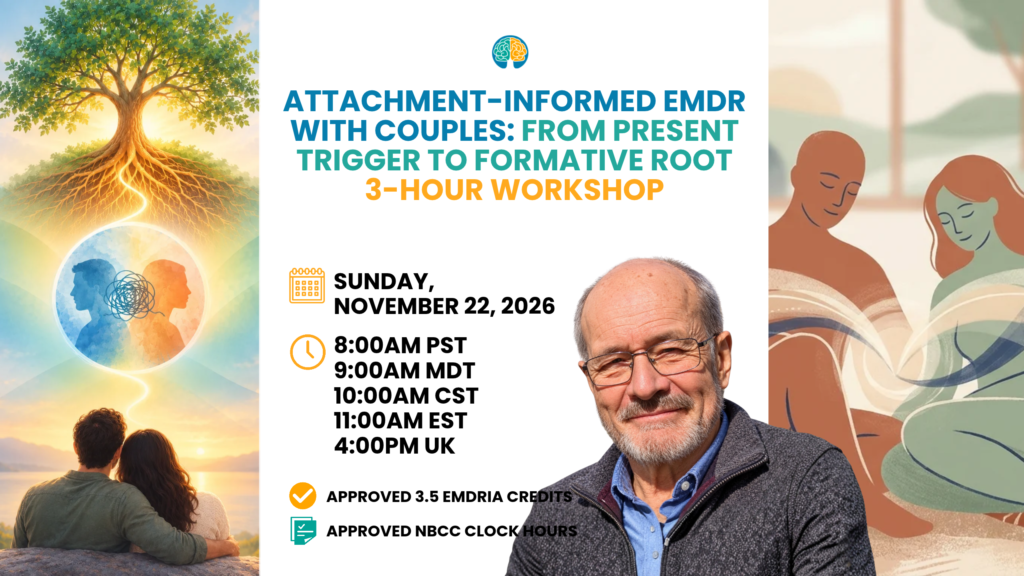

How can you help couples break free from recurring conflict by tracing their split-second triggers back to formative childhood roots?
Join us live on a 3.5 hour training as we explore “Attachment-informed EMDR with Couples: From Present Trigger to Formative Root” with Mark Brayne. In this discussion, you will discover how a couple in difficulty represents two nervous systems in constant conversation, with each partner serving as the other’s primary adult attachment figure. Mark will demonstrate how attachment-informed EMDR (ai-EMDR) works with both partners in the room, guiding clinicians to identify the exact split-second moment in a recurring conflict that fires each partner’s nervous system and bridge from that present trigger back to early attachment roots. You will also learn step-by-step protocols for conjoint processing — where one partner reprocesses trauma while the other serves as a supportive witness and provides therapist-guided tactile bilateral stimulation (tapping) — alongside essential clinical safety guidelines and contraindications.
Schedule: Sunday, November 22, 2026
Timeslot: 8:00am – 11:30am PST / 9:00am – 12:30pm MDT / 10:00am – 1:30pm CST / 11:00am – 2:30pm EST / 4:00pm – 7:30pm UK
👉 Approved 3.5 EMDRIA Credits + additional NBCC Clock Hours
✅ NBCC Approved Program

LEARNING OBJECTIVES:
• Describe attachment dynamics in adult partners: Explain two ways in which adult partners act as each other’s primary attachment figures and how this shapes subconscious reactivity in conflict.
• Identify present triggers and micro-moments: Pinpoint a present trigger, future fear, or pervasive feeling in a couple’s recurring conflict, and guide each partner—by running the scene tightly backwards and forwards—to identify the exact split-second moment firing their survival response.
• Apply the silent joint bridge: Implement the four-part ai-EMDR bridge (image, emotion, body, belief, followed by the instruction to “drop back in time”) in a silent, simultaneous exercise with both partners.
• Explain conjoint reprocessing procedures: Outline the clinical protocol for partner-assisted reprocessing, where one partner acts as the primary client while the non-client partner serves as a supportive witness and provides therapist-guided tactile bilateral stimulation (tapping).
• Evaluate safety criteria & contraindications: List three clinical indications and three contraindications for conjoint EMDR (such as ongoing affairs, coercive control or violence, secrets, or active dissociation) and specify criteria for individual therapy referral.
• Utilize intergenerational extended interweaves: Describe how to apply intergenerational interweaves during processing to help one partner make sense of and resolve their reaction to the other.
Learn how to weave attachment-informed EMDR into your couples practice to transform recurring relational conflicts into opportunities for deep repair and secure attachment. You will leave with concrete, accessible skills to map nervous system patterns, conduct partner-assisted reprocessing, and guide couples from survival-based reactivity toward mutual compassion.
Please note: Registration cannot be completed from an iPhone or iPad. Use a laptop or desktop computer to register.
|
